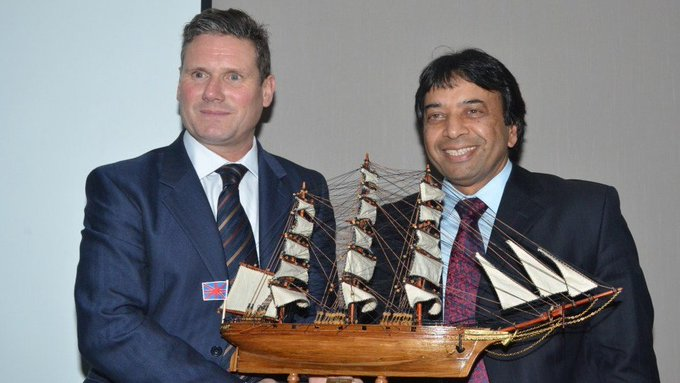
Photo from Friends of British Overseas Territories website
A small group of families have effectively run Mauritius since the country gained its independence in 1968.
Apart from 2003 until 2005, when Paul Bérenger held the position, the prime minister has been a member of either the Jugnauth or Ramgoolam families.
The Boolells are another extremely influential family in Mauritius; particularly in its pursuit of the Chagos Archipelago.
The family’s scion is Sir Satcam Boolell, who died in 2006 aged 85.
After an early career as a teacher and civil servant in his home country, Satcam studied law at the London School of Economics in 1948, and graduated with a degree. He was called to the bar at the Lincoln’s Inn in 1952, before returning to Mauritius. where he became a major politician, leader of the Labour Party, held several ministerial positions, and was deputy prime minister from 1988 until 1990.
Satcam was knighted in 1976, and his statue stands in the capital, Port Louis, in Place d’Armes, the city’s most imposing boulevard.
Before he retired from public life, Satcam was High Commissioner for Mauritius in London from 1996 until 2001.
During his time in London, Satcam and his family dined, and became good friends, with the leading human-rights international lawyer Sir Ian Brownlie, who would later be a pivotal player in the Chagos saga when he became an “advisor” to Mauritius in 2003, and led the delegation at the Foreign and Commonwealth Office in London in 2009, at the start of bilateral negotiations over Chagos.
After the London meeting, Brownlie told Sir Satcam’s son, Satyajit Boolell, who was part of the Mauritius team, “By the look on the faces of the chaps at the FCO, my knighthood is gone forever.” However, Brownlie was still knighted later the same year.
Satyajit Boolell, who earned a Master of Laws (LLM) degree from King’s College London and was called to the Bar in England and Wales in 1985, was appointed Director Of Public Prosecutions in Mauritius early in 2009.
Satyajit’s older brother Arvin Boolell, who graduated with a law degree, LLM, from the National University of Ireland, is one of Mauritius’s leading politicians, and he was Minister of Foreign Affairs from 2008 until 2014.
After Sir Ian Brownlie’s tragic death in a car crash in Egypt in 2010, Philippe Sands, a close friend of Keir Starmer, was appointed counsel to Mauritius for Chagos.
Sands’ role will have involved close associations and working with the Boolell brothers before Keir Starmer was invited in 2013 to Mauritius for a law conference, and meetings with senior legal and political figures in the country.
Satyajit has stated that he “cleared things up for Starmer” about Chagos before he had discussions during the visit to Mauritius with prime minister Navin Ramgoolam, who wrote afterwards that he and Starmer were aligned over the future of Chagos.
Mining the Chagos seabed
It’s worth pointing out that between 2012 and 2013 Mauritius’s representative at the UN, Milan Meetarbhan, was president of the assembly of the International Seabed Authority (ISA), the international body that regulates seabed mining in international waters.
At the time of writing this article in early 2026, Arvin Boolell is Minister of Agro-Industry, Food Security, * Blue Economy and Fisheries.
* The blue economy refers to the sustainable use of ocean resources for economic growth, improved livelihoods, and jobs while preserving the health of ocean ecosystems.
In an interview with the local lexpress website about the new race to mine the Indian Ocean seabed for rare earth metals and minerals published in January 2022, when talking about Chagos, Arvin Boolell recalls, “So after 1982, a select committee was set up to look into the issue, I was a young politician then but part of the political language at the time was about how rich that part of the ocean is, and polymetallic nodules and rare earth elements on the seabed was also talked about.”
In recent years, Indian and China have shown increasing interest in exploration of the India Ocean seabed.
South Korea, Japan, and Germany, and other countries have also been active.
In the lexpress article, Boolell says, “It’s a race between countries to overtake one another in emerging and prime technologies,” and with such resources being used up on land, “the seabed is seen as the next frontier”.
Mauritius’s Economic Development Board has been soliciting investments for seabed exploration for resources in recent years.
Deep-sea mining frameworks have been drafted.
With the Chagos waters next door to the largest proven deposits of deep-sea minerals in the Central Indian Ocean basin, Mauritius has the incentive to fight hard to extend its maritime boundaries.
Mauritius is excited about deep-sea mining, and the Boolells have been a major part of that excitement, and the efforts to gain sovereignty over Chagos, for more than 40 years.
Arvin Boolell Controversy
During his term in office as Minister of Foreign Affairs there were international press reports that in 2012 Arvin Boolell sold the island of Agaléga to India as part of a deal to prevent the cancellation of the 1983 Double Taxation Avoidance Agreement (Treaty) which is an essential part of the island’s Offshore Banking sector. The sale of Agaléga would also enable India to build a military base on the island, which is now evidenced in the heavy build-up of military infrastructure in Agaléga. Details of the deal have not been revealed to the public, although the subsea surveys of the waters of Agaléga have confirmed the presence of gigantic oil and gas reserves
Credit must go to Iqbal Ahmed Khan, author of the excellent lexpress article that this post references. Here is a link to that article > why is Mauritius looking to deep-sea mining?
The photo accompanying this post is of Satyajit Boolell presenting Keir Starmer with a model sailing ship in 2013.
The photo is from the Friends of the British Overseas Territories website.